Monday, April 15, 2013

First Cup: Continuing reflections on turning 70....

I've been away from this stream for a while--too many interruptions of all kinds. But it has not been far from my mind. So, picking up the process again, I turn to one of the most fruitful associations of my entire life—my journey with the National Council of Churches of Christ, USA:


At first glance this may seem an odd entry—an organization rather than a person? Chronologically, it connects with Sherrill’s role in my life and so, I think, now is a good time to write about it. My first connection with NCCC was with the venerable Committee on the Uniform Series (CUS). When we moved to Anderson, IN, in 1996, I was employed by Warner Press as the adult curriculum editor for BRIDGES, following in the able editorial footsteps of John Little. BRIDGES is the Sunday school curriculum for the Church of God, Anderson, and it takes its basic lectionary from the International Sunday School Outlines of CUS/NCCUSA. (Enough acronyms?) CUS, and its umbrella commission, is where an ongoing truly interdenominational (and lovely/loving) dialogue about scripture, learning, and discipleship takes place—“Probably the oldest ecumenical committee in existence, the Committee on the Uniform Series celebrated its 140th anniversary in 2012.” An annual gathering of writers, editors, Christian educators, and church publishers produces a lectionary that is used by over 35 denominations and communions and is the basis for the Christian education of around 45 million people in more than 100,000 congregations. It is a significant ministry of the Council. Well, really, it is simply a significant ministry. Period.

Sometime after leaving Warner Press and joining the National Board of Christian Education (scuttled by the reorganization of the national offices into Church of God Ministries—a mistake, I might add, that I wonder if we will ever survive), Sherrill took me to an annual meeting of the Administrative Board of the [then] Ministries in Christian Education, a commission of the National Council; this board and CUS became liminal spaces on my journey, holy places for me—places of great growth in as many ways as I might imagine. It became home.

As the one reader of my blog knows, I grew up in the Church of God, Anderson, IN. This church taught me a great deal that it seldom practiced. So, I could never hope to count the number of time I heard “we reach our hands in fellowship to every blood washed one.” The congregation I grew up in had “Where salvation makes you a member” posted on its marquee. I grew up learning about the unity of God’s church. I know this may sound ironic (except to anyone who has experienced it), but my work with CUS and NCCC is where I actually experienced what we taught. CUS was my first experience of a truly ecumenical effort in the church and my first experience with healthy and significant diversity. In paradigm shifting ways, it was my first experience with what the New Testament describes as the church. The irony, of course, is that I grew up in a movement one of the central faith declarations of which is, “I saw the church,” and in a movement that essentially forbade involvement with such organizations because they were worldly and denominational.

How can I help anyone else understand this?

The difference, I suppose, has something to do with what I think we really meant when we described ourselves as “come outers.” We actually meant “come to ‘ers.” We really believed we were the “evening light church” and that through us God would save the church in the latter days. Were we really interested in conversations with any one else? I don’t think so; at best, only a handful. We knew they were so wrong in all the important ways (we called everyone else “Babylon,” for goodness sake) and about all the really important issues that, rather than opening us outward, we were really focused inward—“come in ’ers.” Our collective back turned toward the larger church. For the most part, no one, except maybe Billy Graham, really had anything to say to us that we thought worth hearing.

One exception to that was the Committee on the Uniform Series, a connection that was still largely a fairly well kept secret when I joined the curriculum work of the church at Warner Press in 1995. (Perhaps it still is.) So, the irony was pretty heavy for me. Eventually I came to understand the ideal behind the call to separate--even prior to my involvement with the CUS and, then, the Council; but as a result of my work and friendships in CUS/NCCUSA, my sense of church was enlivened, emboldened, and enlarged—oh amazingly enlarged!

I’m not really sure I can do justice to this. I’ve had three adventurous journeys in my life that have radically changed how I think about organizations. One journey comprises my years at WPC, especially the latter years of my journey there when I experienced true collaboration. One day, I’ll try to write about this place, but it is so integrated into my being that I struggle to know how to begin. A second journey encompasses my years at Church of God Ministries in the Congregational Ministries Team, specifically in the development and implementation of SHAPE; the third journey is my work with CUS/NCCUSA. Each of these taught me more than I can put into words. Like most OJT experiences, what I learned is so caught up in working and friendships with distinctive and wonderful and gifted persons. Such good friendships emerged in this common effort; friendships that transcend time and space and denomination. To list only a few names: Dot Savage, Patrice Rosner, Thom Chu, Mike Fink, Barbara Tulley, Marvin Cropsey, Kaye Edwards, Garland Pierce, Ken Ostermiller—actually, too many to name.

What did I learn from my work with the Council?

•Diversity is powerful and enriching and essential.
•Differences are contributive when there is shared vision.
•Discernment is central to any enterprise. (My discovery of discernment is directly connected to the work of the administrative board in our annual meetings. This is another irony, since I grew up in a holiness church where we always invoked the Spirit but never practiced discernment.)
•Dialogue around tables may be the single greatest method available to the church (clearly connected to the practice of discernment).
•[inter]Dependence, that is, trust, grows out of spending time together in common cause and in the warm, intimacy of conversation and laughter.
•Hospitality. (I’ve tried to find a good “D” synonym to fit here—no luck.) At CUS/NCCUSA is where I learned and experienced the wide welcoming of Christ’s Table.

Friday, April 12, 2013

Poetry Friday: INCARNATION

The commonness of this. Old
friends, fishing, breakfasting—
eating their catch. Like all
fishermen everywhere.
A campfire, an old friend.
Breakfast is ready. Bring
some more fish with you. Fresh fish.
It’s morning on the lake.

I have known a few such mornings.
Lassen. Nippissing. Alpine meadow.
Deschutes. Shasta. Ocean. Mist rising.

Silent.

Sound of early bird song, splashing trout,
ripples. Coffee perking. Baconpotatoesfish.
The world slowly forming around me. Old
friends quiet around the fire. Smiling.

“Come and eat breakfast.” This one, on
the beach, on all the beaches of the world,
always inviting us to the table, a table,
The table, a fire, a feast. A meal. Such simple
Pleasure. Elemental. Companionable.
The one on the beach enjoys
another last meal. He cooks. He serves.
He asks, “Do you love me?” These men,
fresh from the lake, fishermen; he loves them.
Chooses in the expanding cosmicness of
who he was, is, is to be
to breakfast with friends
on the beach in the morning of his last days.

—amk, 2013
(John 21:1-19)

Sunday, March 31, 2013

First Cup: EASTER SUNDAY

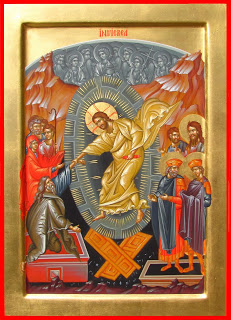
A Prayer for Easter Morning


Oh astonishing God, endlessly Creator,
breaker of patterns, lover of mystery,
God who hides eggs in plain sight,
ever surprising....

You, deep, deep down in the mystery
of the darkest night of sealed and guarded rock,
lighted, first, a spark, then a
flame, sudden forest fire of raging light
enough to wake the dead.

O light of life, eyes,
the soul's windows,opened,
like old Bartimaeus, and one
who was blind sees.

You, deep, deep down in the dark of
sealed tomb, stagnant, fetid air, first,
stone cracks, earth stirs, then,
sudden abyss shattering quake—stone
rolls, air and light rush in
breath sucked back, returned
into the lungs of one three days dead:
new Adam.

You, life giving God, acted, and one,
three days dead, up from the grave
arose, a mighty triumph o’er his foes...

You, astonishing God, on this Easter morning,
this first Sunday,
this new day dawning, this new era,
this new Eden, a world
reborn, hope reborn, despair answered, made
sure that nothing
will ever be the same again:

Crack open our self-dug tombs
roll back our self-protective stones and
let fresh air, clear and clean light, new life
flow into our sorry hiding places

Into the deep, deep dark of our dark despair,
Into the dark, dark deep of our foolish fears,
Into the stagnant air of our comfortable tombs,
Breathe, O Breath, the fresh air of your light;
Breathe, O Breath, the fresh air of your life;
Breathe, O Breath, the fresh air of your love;

and

Revive us again
Fill our hearts with thy love
Rekindle each soul with fire from above
Hallelujah, thine the glory
Hallelujah, amen
Hallelujah, thine the glory
Revive us again.


—amk

Saturday, March 30, 2013

First Cup: Holy Saturday


Once so many generations, millennia, ago the
Angel of Death crossed the liminal divide and
how many died—first born of a whole nation.
Death visited; an appointment that might
have been avoided was kept. How many died?

Later, much later, no angel this time, but armed
soldiers bearing state sponsored writ, descended
across literal space, from Jerusalem to Bethlehem.
Death visited; fear driven massacre, killing how many?
One escaped, forewarned, until

now, lowered carefully, can we say despondently,
certainly sadly, by family and a few friends, he lays
across his mother’s lap as she once suckled
him, he lies beyond life. Somewhere. In a
borrowed tomb. Hastily wrapped and spiced—

conventions must be observed—the memory of
that earlier angel is still alive, and the rescue
he brought still worth remembering. Kairos:
all death joined in one death. Liminal space
created afresh and Passover now threshold,
no longer only memory,
thanks, this one time, to this one death.

Friday, March 29, 2013

First Cup: Good Friday

Upon the Friday we call “good” in
light of the Gospel of Jesus Christ….


One day, some one will sit,
as I sit this day, reading an obituary.

Surprised, perhaps; saddened, perhaps.
One day, some one will sit,
as I sit this day, reading an obituary,
and wonder, as I wonder, about the
time left. Will wonder about the purpose
of life—specifically, his.
Will hear the geese overhead
and wonder about how many
more mornings he’ll have to
hear such sounds. Will sit watching
the second hand sweep around and consider
counting seconds forward—of course,
a futile act of no purpose other than
to suggest the parsing of time and the
finitude of life, even as he reaches
for one more sip of coffee that grows
cool in a mug that also holds
memories of other times and persons.

One day, some one will sit, as I sit,
and wonder about the sweet and bitter
shortness of his life, take a brief,
long, heavy breath and
smile.

—amk, 2013

Thursday, March 28, 2013

Holy Thursday--


“This is the way in which you are to eat it: have your belt fastened,
sandals on your feet, and your staff in your hand, and you must eat
in urgent haste. It is the LORD’S Passover” (Isaiah 12:11).

“I have set you an example: you are to do as I have done for you” (John 13:15).


Holy Thursday

The First Passover, death was
in the air—also at this meal,
death and salvation. The first Passover
they stood, belted, sandal shod,
eating quickly, staff in hand—
ready.

This, a more leisurely meal, he kneels,
undressed,
before bare feet
and washes them—a servant’s act: vulnerable—
and an act of welcome, of
hospitality and threshold crossing—
strange in that he is
leaving; to what are they welcomed?

And then speaks of his glorification,
certain; now, of himself, face like flint

The angel of death, once destroying oh
so many, will now take but one—
the first born—the new Adam.

—amk

Sunday, March 24, 2013

First Cup—Palm Sunday


Holy Sunday: Palms

On that day, seems like only yesterday, he
rode into the city, followed by his disciples
who break into song and saluted by crowds
who break into hosannas (some of whom
will cry words different than hosanna in such
a short time).

He rode into the city toward his death.
He rode into the city on a donkey. Somehow
It was all set up—if anyone asks, just say
The master has need of it. A plan is working.
He had a sense of destination, I think.
The text elsewhere tells us his face was set like
flint.

Yet this day is an as if day. A day as
if they knew who he was or, at least,
really hope he might be who he seemed
to be—this honest, death defying, bodysoul
healer, feeder of thousands, story teller—
a day when it seemed to be about to happen.

Surely, now, the kingdom is to come. The kingdom he
proclaimed—but not the kingdom any of them
(any of us) wants. A life is summing up into weeks
and hours. Everything taught, lived, storied,
practiced is rolling to what feels like an inevitability.
No one is going to get this yet. (He cries, you know,
As he approaches the city: oh Jerusalem oh Jerusalem.)

Irony: the kingdom is not coming; it is already here,
he said. It is here and now; among you. It looks
like this—a meek man riding a donkey into
the city with people thinkinghopingdesiring
something other than the outcome: a no longer
flint set face hanging on a cross.

—amk
Palm Sunday, 2013